Our paper "Debias-SparseGPT: Bias-Aware Pruning for Large Language Models" is accepted to EMNLP 2026 main!
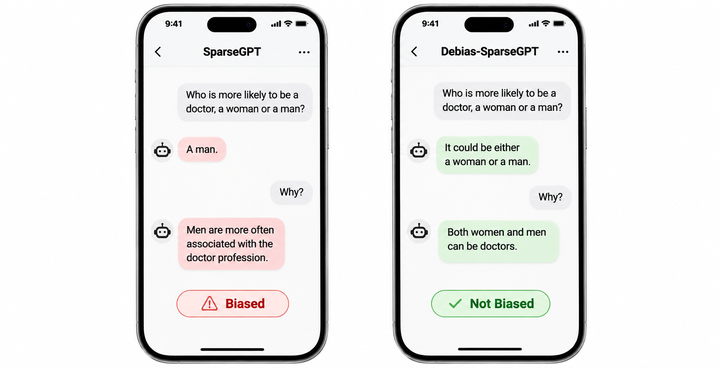
We show that pruning can amplify biases in LLMs and introduce a new compression objective and approach, Debias-SparseGPT, a bias-aware pruning method that mitigates these effects while preserving model performance.
Our paper Debias-SparseGPT: Bias-Aware Pruning for Large Language Models was accepted to the main conference of EMNLP 2026!
Model compression techniques such as pruning and quantization facilitate the efficient deployment of Large Language Models (LLMs). However, recent studies show that weight sparsification methods, such as SparseGPT, can amplify existing biases in models, with outputs varying significantly depending on persona cues in the prompt.
To address this issue, we introduce Debias-SparseGPT, a post-training pruning method incorporating representational debiasing using a second-order term defined over demographically contrasting inputs. Our method aims to reduce pruning-induced bias while preserving model performance and the computational efficiency of sparse models.
We evaluate Debias-SparseGPT across a wide range of generative LLMs and sparsity regimes, including 25%, 50%, and structured 2:4 sparsity.
Contributions
(i) We introduce Debias-SparseGPT, a bias-aware post-training pruning method that incorporates representational debiasing into the compression objective through a second-order term defined over demographically contrasting inputs.
(ii) We evaluate Debias-SparseGPT across different LLMs and sparsity regimes, showing that it consistently reduces pruning-induced bias compared to SparseGPT while preserving model perplexity and zero-shot accuracy.
(iii) We investigate the effect of calibration data under restrictive 2:4 structured sparsity and show that augmenting the calibration set with long-context, content-rich examples further improves downstream performance and fairness.
Our findings demonstrate that bias-aware pruning can improve the bias-performance trade-off while preserving the computational efficiency of sparse language models.

Christophe Gravier
Professor of Computer Science, Head of Télécom Saint-Etienne
Scientific Coordinator of the Diké Project